Boiler efficiency is undoubtedly the most important and most widely used term when the subject of purchasing a new steam system comes up. Unfortunately, the goal of the industry at times seems to make understanding efficiency as difficult as possible through the use of terms and equations provided in the language of a seasoned engineer, terms that don’t even begin to make the slightest bit of sense to a beginner or casual user. While there are numerous factors that can contribute to the actual efficiency, having a perfect understanding isn’t critical. However, general knowledge of terminology and principles can go a long way in helping you come to an assured and confident decision.
In the following article, we’ll be breaking down the subject of boiler efficiency, and how it relates to making a new purchase. We’ll also provide a few tips to help you understand the ins and outs of this subject, as well as a few of the hard questions to ask any potential supplier.
Why Does Efficiency Matter?
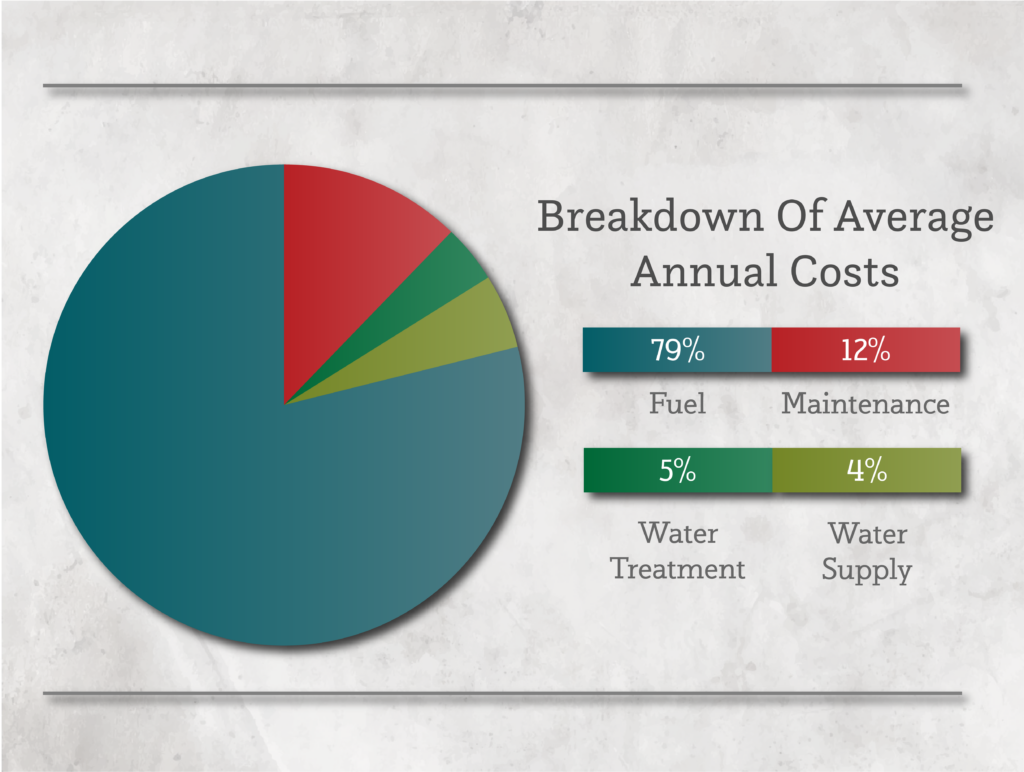
Good question! The reason that efficiency is so important comes down to your fuel bills. In the average industrial scenario, the final cost of your new steam system, delivery, and installation pales in comparison to the amount you will spend in fuel over the lifetime of the boiler. It’s not uncommon to spend two to three times this amount in fuel in the first year alone. This represents a continuing annual expense that you’ll be paying for as long as your boiler is in operation.
This is why efficiency is so important, it directly impacts your yearly costs, and as little as one percent in efficiency can equal tens of thousands of dollars. While the natural inclination may be to accept lower cost up front, this decision could result in hundreds of thousands of dollars in increased fuel bills over the years to come.
What Is Efficiency?
Boiler efficiency represents the difference between your energy input and output expressed as a percentage, or how much steam your boiler is able to produce relative to your fuel usage. However, this term is often used as a general blanket statement to summarize any and all of the factors that may be contributing. When this term is being used, its important to understand what is or is not being represented, something your potential supplier should be able to provide you with.
For example, to get a quick breakdown of your efficiency rating, simply take your boiler’s output and divide by your input. This will provide you with a starting point for your inquiries, but keep in mind that this doesn’t take into consideration all the factors that may be affecting your efficiency and only provides a general reflection.
Oftentimes, a supplier may provide this number as their final efficiency rating, so be sure to ask them. Further, energy input and output should be freely listed on any boiler company’s website and in their technical documentation so that you can run the numbers yourself. If these numbers are difficult or impossible to find, it may raise some questions about their reputability.
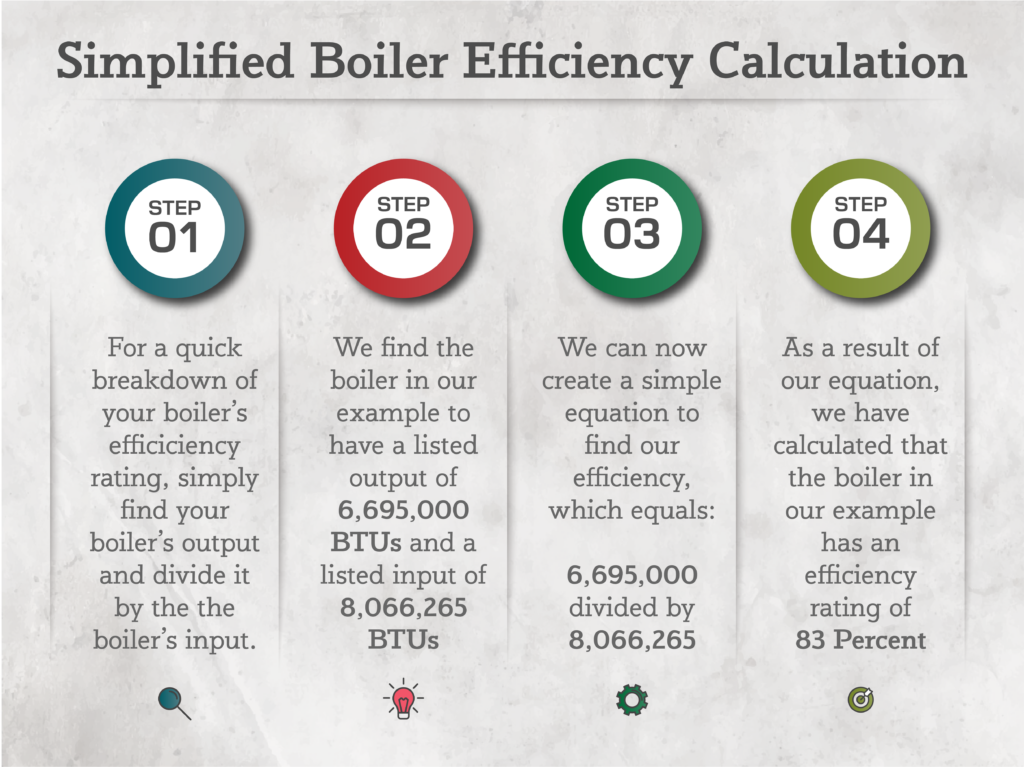
This can be expressed as 6,695,000 divided by 8,066,265 = 0.83
Therefore, this boiler’s efficiency rating is 83%
Terminology and Calculations
There are several areas of consideration that contribute to determining your boiler’s true efficiency. Here are some of the terms that you may encounter when discussing this subject:
Thermal Efficiency
When used in reference to steam boilers, this refers to the effectiveness of your heat exchanger, or more directly how well heat is being transferred from your fuel supply into usable steam. However, the focus is on your heat exchanger, not on your boiler, even though this term is often mistakenly applied to boilers. Thermal efficiency is a factor in your overall efficiency, but not the be all and end all that it is commonly presented as, and as a result it is not a useful term when comparing one boiler to another.
Combustion Efficiency
This is a measure of how well your boiler is burning fuel. It specifically refers to the total heat released during combustion, minus heat that is lost in the combustion process. Under ideal circumstances, your boiler’s combustion will result in low levels of unburned fuel and low levels of excess air. However, in a real-world application, combustion conditions are never perfect, and will always require some measure of excess air to burn completely. Finding this balance becomes crucial. Not enough air will result in unused fuel and the production of soot and carbon monoxide, whereas too much air will result in heat losses. Both scenarios have a negative impact on your savings.
Taking this measurement is easily done through a quick analysis of your combustion air by means of a combustion analyzer, and is a good way to compare performance between boilers.
Heat Losses
While not technically a measure of efficiency, there are three general types of heat loss that effect your boiler, and heavily contribute to your overall efficiency in the form of wasted energy.
- Convection Loses refer to heat that is lost from air flow surrounding the boiler.
- Radiation Loses refer to losses from heat that radiates from the boiler shell.
- Stack Losses refer to heat that is lost by exhaust gases that exit the boiler stack, having never transferred their heat.
When you enter a boiler room, do you immediately notice how hot the room is? Do you hesitate to get too close to the boiler, out of fear of burning yourself? This is a sure sign that a boiler is experiencing high heat loss.
Fuel To Steam Efficiency
This is the best possible measurement of efficiency. It considers the final amount of energy that is being converted into steam, taking into consideration all the factors that contribute to your boiler’s overall efficiency. When a potential supplier begins discussing their products with you, this is what should be presented to you as a customer.
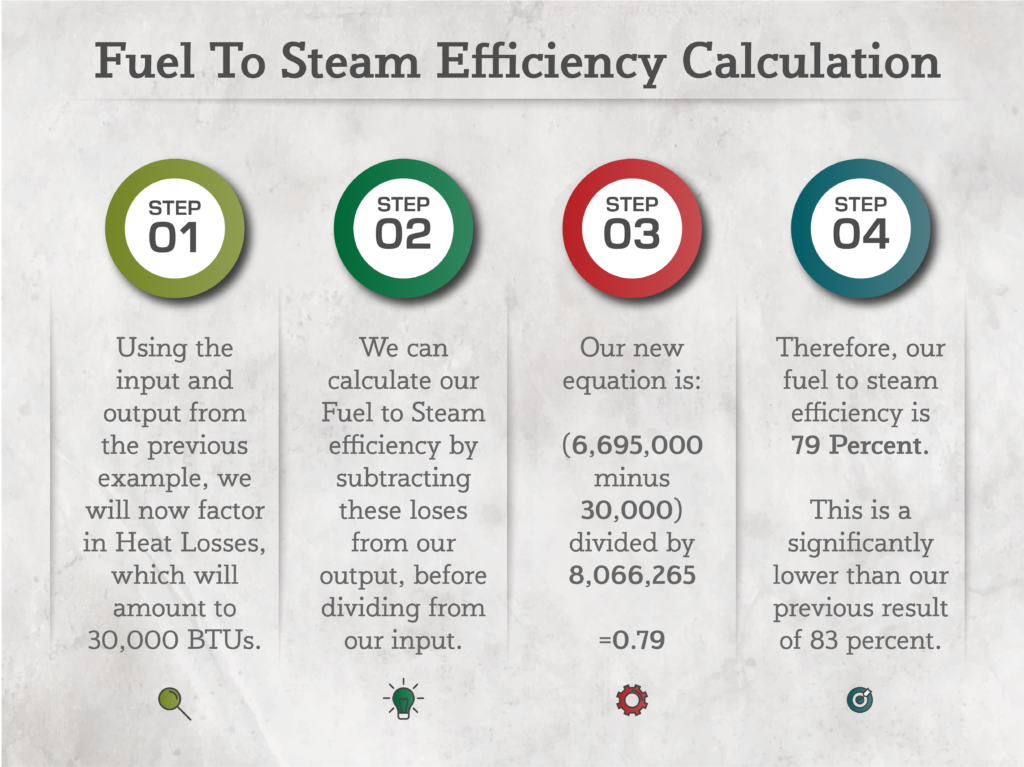
We can find our Fuel to Steam Efficiency by subtracting our losses from our output, and then dividing by our input.
This can be expressed as (6,695,000 – 300,000) / 8,066,265 = 0.79
That means that our Fuel to Steam efficiency is 79%, which has dropped considerably from our previous measurement of 83%.
Beware False Claims
As you can see, there’s a great deal to cover when it comes to efficiency, and there are more factors to take into consideration when determining your true boiler efficiency, such as feedwater temperature, steam pressure, firing rates, and blowdown. So why doesn’t every manufacturer provide these numbers? Sadly, as we’ve all experienced first-hand in life, not everyone is in the habit of practicing transparency. There are plenty of industry tricks that can be used to artificially boost efficiency numbers, and you don’t want to find out too late that you’re losing money.
The best way to avoid this situation is to ask any potential supplier to provide a real-world efficiency rating for their boiler. Different manufacturers may call this by different names, but what you should be getting is a realistic efficiency rating, based on the conditions of your plant and inclusive of all losses.
Don’t settle for a manufacturer providing you a hypothetical rating based on what they have deemed to be ‘ideal conditions.’ The easiest and oldest trick to boost efficiency ratings is to run the boiler under perfect conditions, with ideal water temperature, perfect fuel combustion, and without any heat losses whatsoever. These conditions seldom exist in the real world, so make sure that the number that is being provided is realistic to you and your needs, not someone else’s idea of perfection. What temperature will your feedwater be? What pressure will you be operating at?
There’s an old saying about comparing apples to apples, and how it relates to drawing an even comparison. Comparing a real-world rating with an ‘ideal’ one isn’t a similar assessment. Getting this information from multiple suppliers allows you to make an accurate decision between them, to compare apples to apples, as it were. Any supplier that is unable or unwilling to provide this information may be trying to hide something.
Final Thoughts and Future Considerations
We’ve only just scratched the surface when it comes to breaking down boiler efficiency, however you don’t need an encyclopedic knowledge in order to make an informed decision. By following these basic steps and asking a few questions of any sales personnel, you’ll be well on your way to making an informed decision about your new steam system.
If you’ve made it all the way to the end of this article, you might be wondering about some of the other terms or principles that were briefly mentioned in this article and the questions that they raise. What is a boiler’s firing rate, and how can it influence efficiency? Does the temperature of my water really make a difference? Does boiler blowdown play a role in efficiency?
These are all excellent questions, and we’re pleased to say that the answers to these questions will be answered in a series of educational articles that Clayton will be providing here on our website. We invite you to check back in the future for more articles as they become available.