
Concrete Industry
Home > Industries > Concrete
Clayton Industries Supports the Concrete Industry
Concrete is a hardened building material created by combining a mineral aggregate such as sand, gravel, or crushed stone with a binder such as cement, chemical additives, and water. Cement is commonly used as a synonym for concrete but the two are quite different. Cement includes a wide variety of fine-ground powders that harden when mixed with water and makes up one of the components in modern concrete. As concrete dries, it acquires a rock-hard consistency that renders it ideal for constructing.
Steam is used to heat aggregate piles in cold weather, as well as use in curing hydration in the product. In pre-stressing and precast plants, steam provides high early strengths, enabling rapid de-molding and reuse of forms. Steam usage speeds up “curing or setting” of concrete and makes it stronger. In some processes, steam cured concrete can obtain the strength of 28 day normally cured concrete in just 3 days.
Each concrete product requires a set temperature and pressure specific to its design. Some processes will require various periods of time at different pressures and temperatures which will fluctuate over the curing process, so precise control is needed. Once in the cement kiln line, curing generally takes place in large ovens or autoclaves where this precise control of steam temperature and pressure is critical to the quality of the finished product.
Clayton’s instantaneous response and precise steam supply at verifying pressures and demands make our Steam Generator perfect for this application.

Key Benefits
Rapid Response
Clayton Steam Generators are designed to ramp up to meet the needs of your production, delivering exceptional steam quality during peak production, as well as when your needs are lower.
Lowest Cost of Ownership
Clayton’s high efficiency design offers industry leading efficiency, bringing massive savings in the form of greatly reduced fuel consumption.
Precision Control
Clayton offers an unrivaled level of control over their steam generation, giving you the perfect temperature and pressure at the push of a button.
Featured Case Study
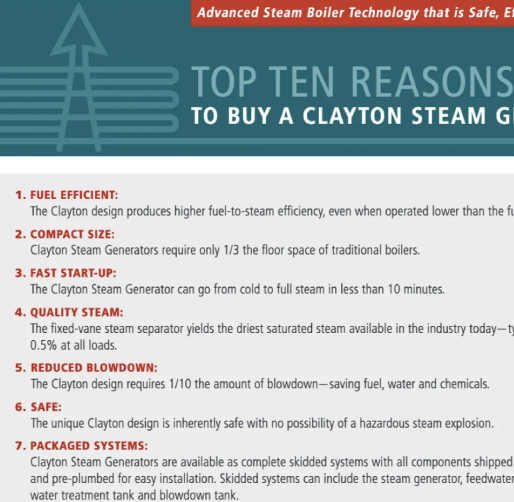
Top 10 Reasons To Buy a Clayton Steam Generator
1. FUEL EFFICIENT:
The Clayton design produces higher fuel-to-steam efficiency, even when operated lower than the full firing rate.
2. COMPACT SIZE:
Clayton Steam Generators require only 1/3 the floor space of traditional boilers.
3. FAST START-UP:
The Clayton Steam Generator can go from cold to full steam in less than 10 minutes.
4. QUALITY STEAM:
The fixed-vane steam separator yields the driest saturated steam available in the industry today — typically less then
0.5% at all loads.
Frequently Asked Question's
Steam boilers supply steam for accelerated curing in precast and prestressed concrete plants. They can also support aggregate heating during cold weather. These applications help producers manage curing conditions and maintain production when outdoor temperatures fall.
Steam curing provides heat and moisture in an enclosure around freshly cast concrete. The warmth accelerates cement hydration, while moisture helps prevent premature drying. A controlled cycle includes an initial waiting period, gradual heating, a holding period, and gradual cooling.
Yes. Controlled steam curing can accelerate early strength development, allowing earlier demolding and reuse of forms. However, the time needed depends on the concrete mixture, product, and curing conditions. Release decisions should follow the plant’s specified strength-verification procedure rather than a fixed steaming time.
The temperature must follow the approved curing procedure for the concrete product and mixture. For wet-cast precast concrete, NPCA’s guidance describes low-pressure steam-curing maximum temperatures of 120–140°F, with controlled heating and cooling. This range should not be treated as a universal setting for every concrete process.
Yes. Applying heat too early, heating excessively, or cooling too quickly can impair concrete quality. Effective steam curing requires control of temperature changes and moisture throughout the cycle. Starting elevated-temperature curing after initial set and cooling gradually helps protect the product.
Boiler capacity should reflect the heat and steam required by the curing areas operating simultaneously. Account for concrete and form temperatures, warm-up time, enclosure heat losses, and any additional heating duties. Evaluate peak startup demand separately from the lower demand needed to maintain curing conditions.
Yes. Steam can heat aggregate piles and support controlled curing conditions in cold weather. Cold temperatures slow cement hydration, so maintaining suitable material and curing temperatures helps keep production consistent. Heating must follow the plant’s cold-weather concreting procedures.
Yes, provided the generator and distribution system can meet the combined demand. Curing areas may require different amounts of steam as they enter heating and holding stages. Assess overlapping production schedules and provide suitable controls for each area when designing the system.
Repair steam leaks, maintain insulation, and keep the boiler properly tuned. Match steam production to the curing schedule and inspect distribution equipment regularly. Where suitable condensate can be recovered, returning it to the boiler system can reduce replacement-water and heating requirements.
Provide the curing method, required steam conditions, production schedule, and estimated normal and peak demand. Include the number of curing areas, site utilities, feedwater conditions, and expansion plans. This information helps Clayton assess a system suited to the plant’s production requirements.

Contact a Clayton Representative