
Wire & Cable Industry
Home > Industries > Wire & Cable
Clayton Industries Supports the Wire & Cable Industry
Wire and Cable is a significantly larger industry than your average consumer may realize, as it is directly responsible for providing electricity, telecommunications, and data transmission. The manufacturing process typically starts with metals such as copper or aluminum, which are then wrapped in an insulated material, such as rubber, PVC, or other kinds of polymers.
The manufacturing process typically begins with creating a mechanical cable capable of carrying electrical current, typically made of copper, aluminum, or other alloys, depending on the application. Once this has been created, the cable will need to be drawn into an insulator and covered completely, in a process referred to as Extrusion. Raw materials used for insulation, typically in the form of pellets, are heated and melted. This process not only allows the material to be shaped, but also causes it to undergo a chemical change which makes the materials more heat resistant and durable. Once melted and cured, the hot insulator will pass through a mold to create the desired shape. As this shape is created, mechanical wire will be fed into it, along with another heat treatment, to cause the insulation to shrink and adhere tightly to the cable, forming a perfect layer of insulation, before being cooled and wound onto reels for distribution. Steam is utilized throughout this process as the ideal method of heat application.
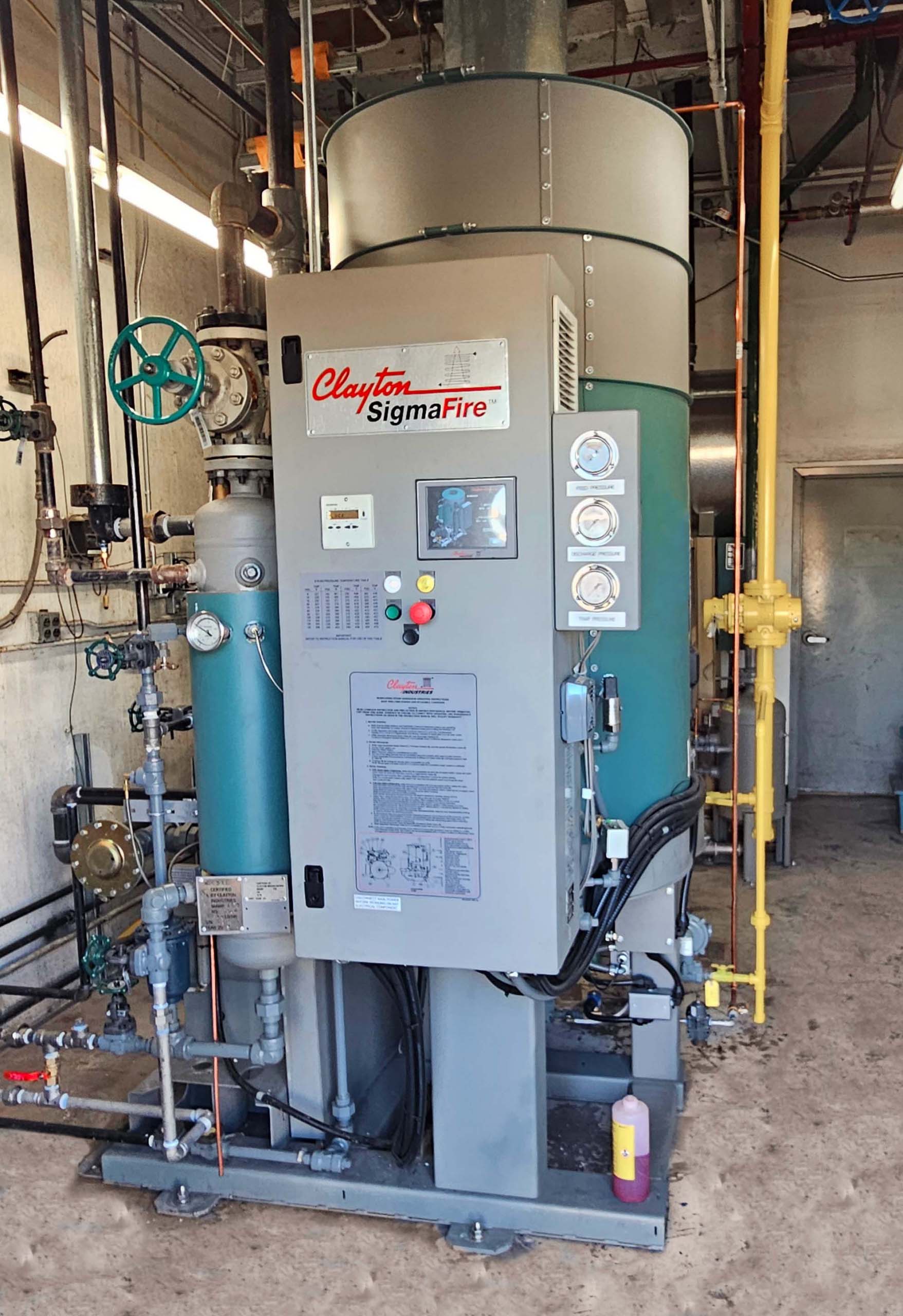
With its precise temperature control and high quality dry steam, the Clayton Steam Generator’s efficient And fully modular design is an ideal choice to supply steam heat to the wire and cable industry.
Key Benefits
Precision Control
Get perfect temperature and pressure every time with Clayton’s easy to use control scheme.
Rapid Response
Clayton’s fully modular Steam Generators are designed to handle the peaks and valleys of the production cycle, ramping up when you need them and slowing down when your demands decrease, all without sacrificing steam quality.
Inherent Safety
Clayton’s coil type water tube design completely eliminates the chance of a catastrophic steam explosion, keeping your facility, product, and workers completely safe.
Featured Case Study
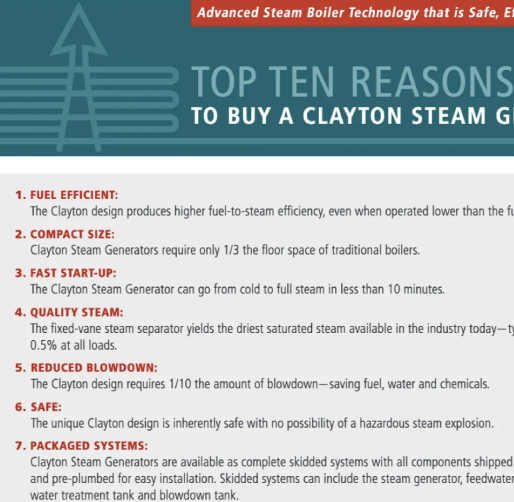
Top 10 Reasons To Buy a Clayton Steam Generator
1. FUEL EFFICIENT:
The Clayton design produces higher fuel-to-steam efficiency, even when operated lower than the full firing rate.
2. COMPACT SIZE:
Clayton Steam Generators require only 1/3 the floor space of traditional boilers.
3. FAST START-UP:
The Clayton Steam Generator can go from cold to full steam in less than 10 minutes.
4. QUALITY STEAM:
The fixed-vane steam separator yields the driest saturated steam available in the industry today — typically less then
0.5% at all loads.
Frequently Asked Questions
Steam boilers supply heat for cable production processes that use steam curing, particularly continuous vulcanization of rubber insulation and sheathing. The steam system must deliver the pressure, temperature, and flow required by the curing line to maintain consistent processing conditions.
Continuous vulcanization, or CV, cures suitable insulation or sheathing compounds as the cable moves through a production line. In steam-based systems, the extruded cable passes through a pressurized steam curing section before cooling. This allows extrusion and curing to operate as a continuous process.
No. The curing method depends on the insulation material and cable specification. Steam curing is used for certain rubber cables, while nitrogen curing is an option for materials requiring a dry processing atmosphere. Boiler requirements should therefore follow the selected production process.
No. The curing method depends on the insulation material and cable specification. Steam curing is used for certain rubber cables, while nitrogen curing is an option for materials requiring a dry processing atmosphere. Boiler requirements should therefore follow the selected production process.
The appropriate steam condition depends on the curing line and compound. Some systems use saturated steam, while equipment manufacturers also offer superheated-steam configurations for particular products. Confirm the required steam condition with the line supplier before specifying a boiler or superheater.
There is no universal setting for every cable curing line. Required conditions depend on the equipment, compound, and production recipe. Specify pressure and temperature at the curing equipment, then account for distribution losses and controls when selecting the steam generation system.
Consistent steam conditions help the curing line maintain its specified thermal process. Changes in pressure, temperature, or entrained moisture can affect heat delivery. Clayton’s wire and cable page identifies pressure control, dry steam, and rapid response to changing demand as key features for these applications.
Start with each steam-consuming line’s required flow, pressure, and steam condition. Calculate simultaneous demand, including startup loads, and assess minimum consumption during reduced production. Planned expansion, distribution losses, and backup requirements also influence the appropriate boiler capacity and number of units.
Yes, provided the boiler and distribution system can meet their combined demand. Lines starting together may create a larger peak than normal production. Review operating schedules and individual pressure requirements to determine whether a shared boiler or multiple staged generators best suits the plant.
Clayton states that its steam generators can reach full steam output from cold in under 10 minutes. Actual readiness depends on the selected configuration and installation. The curing line and steam piping also need time to reach their specified operating conditions before production begins.
No. Dry steam means water vapor with little entrained liquid water; moisture is still present as vapor. Nitrogen dry curing uses a different atmosphere for materials sensitive to moisture or oxygen. A steam separator improves steam dryness but does not make steam curing equivalent to nitrogen curing.
Contact a Clayton Representative