
Chemical Industry
Home > Industries > Chemical
Clayton Industries Supports the Chemical Industry
We all use various chemicals in our daily lives. From the paint that we use in our home, the absorbent material in diapers, fertilizer for our gardens, or a small pill to help relieve a headache, we rely on chemical companies for for a regular supply of these products. The chemical industry involves numerous production processes to provide these products for us, including oil refining, synthetic reactions, distillation, and drying.
In some chemical plants for instance, steam is the most effective way to bring a reactor up to its required temperature. Specific temperatures are required for each chemical reaction to take place. Therefore, precise control of the steam pressure is required in the steam distribution system and at its point of use, as variations in temperature and pressure can greatly influence reaction rates and product quality.
Distillation is a common way of separating different components of a mixture, including fraction separation and the separation between gas and liquid phases, much the same way as is used in the manufacture of alcoholic spirits. Heat is used to create vapor, which is then sent to a condenser, and finally cooled into a pure product.
The process of drying can be accomplished in a number of ways, all using heat from steam to vaporize or evaporate water. This includes air drying, adsorption drying and spray drying.
Another common usage of steam is to heat up the reactants through a heat exchanger, before it is transferred to a reactor or the heating jacket, thus supplying the necessary amount of heat.
Petroleum refining, or turning crude oil into a wide range of petroleum products, requires a large amount of steam energy to heat, distill and separate various products from crude oil. Other uses include catalytic reactions such as cracking and hydrogenation.
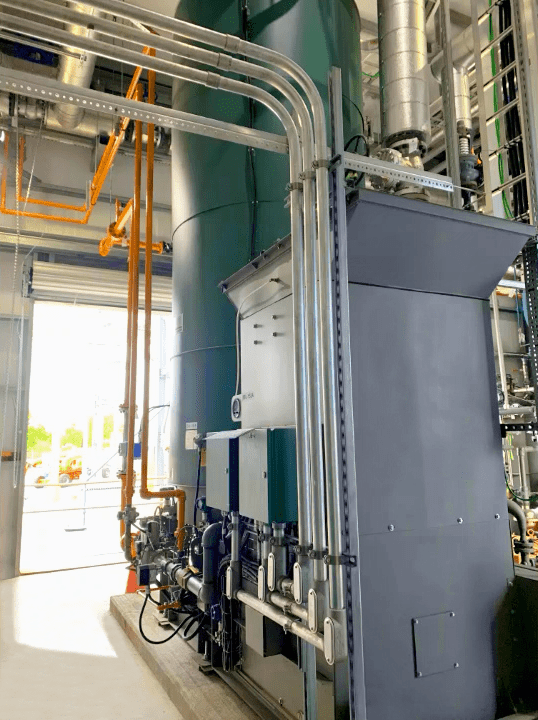
Clayton Steam Generators have long been the boiler of choice for many of the world’s leading chemical companies. With our steady supply of quality steam, provided at a stable pressure and temperature, Clayton Industries is standing by to provide a customized solution for your next project.
Key Benefits
High Quality Steam
Clayton Offers steam of an exceptional quality regardless of your current demands, helping you to achieve a quality product every time.
Precision Control
Clayton Steam Generators offered an unparalleled level of control, guaranteeing your needs are met regardless of your application.
Fully Customized Solutions
Regardless of the needs of your facility, Clayton is standing by to offer a solution customized to the specific needs of your facility, from a correctly sized boiler through to feedwater and chemical treatment options.
Featured Case Study
Young Living Farms installed Clayton steam generators
Young Living Farms, headquartered in Lehi, Utah, produces the best essential oils in the world. Fueled by a growing demand for top-quality essential oils, it now has offices in Australia, Europe, Canada, Japan, and Singapore – and farms located around the world. Young Living sells its products through a global network of member distributors, so main- taining inventory and controlling costs is imperative.
“The older firetube boiler Young Living had been using at its Highland Flats Distillery in Naples, Idaho, was not nearly as effi- cient as it needed to be for a global leader in essential oils,” said Mario Talavera, Sr., Western Regional Sales Manager for Clay- ton Industries.
Frequently Asked Question's
Steam boilers supply process heat for reactor heating, distillation, drying, and preheating raw materials. Chemical plants also use steam in refining and separation processes. The required steam conditions depend on the equipment, materials, and production method.
Steam can supply heat through a reactor jacket or heat exchanger, bringing reactants to the temperature needed for processing. In an indirect heating arrangement, a heat-transfer surface separates the steam from the chemicals. This allows heat to enter the process without intentionally mixing boiler steam with the product.
Stable steam pressure helps maintain consistent heating conditions at the point of use. Pressure fluctuations can affect process temperatures, which may influence reaction rates and product quality. Chemical plants therefore need suitable controls throughout the steam distribution system and at individual processing equipment.
Steam supplies heat to vaporize components of a liquid mixture, often through a reboiler or heat exchanger. The vapor is subsequently cooled and condensed as part of the separation process. The required heat input depends on the mixture, operating pressure, and separation goals.
Saturated steam is generally preferred for indirect process heating because it releases substantial heat as it condenses at a temperature determined by its pressure. Superheated steam serves applications with different requirements, including some turbine and specialized processes. Selection should follow the equipment’s heat-transfer and operating requirements.
Boiler capacity should match the highest realistic simultaneous demand from reactors, reboilers, dryers, and other steam users. Include startup loads, distribution losses, and any defined expansion requirements. Also assess minimum demand and the duration of production peaks so the system can operate effectively across the plant’s workload.
There is no single steam pressure suitable for every chemical process. Establish the pressure and temperature required at each piece of equipment, then account for distribution losses when specifying the boiler. Processes with different requirements may need separate pressure-control arrangements supplied from a common steam system.
Trapped air and inadequate condensate drainage can reduce heat transfer even when steam is available. Steam traps and air vents must suit the equipment and handle both startup and normal operating loads. Checking these components can help identify heating problems before increasing boiler capacity.
The choice depends on demand variation, maintenance needs, and the consequences of losing steam supply. Multiple boilers can provide operating flexibility as production changes. However, installing several units does not automatically provide full backup capacity; the remaining units must be able to meet the required load when one is unavailable.
Repair leaks, maintain steam traps, insulate steam and condensate piping, and keep boilers properly tuned. Recover suitable condensate where possible to reduce replacement water and heating requirements. Regular system inspections help identify avoidable losses and prioritize maintenance work.
Contact a Clayton Representative