
Automotive Industry
Home > Industries > Automotive
Clayton Industries Supports the Automotive Industry
You could argue that the automotive industry began on January 29, 1886, when Carl Benz applied for a patent for his “vehicle powered by a gas engine”, patent number 37435, which is sometimes considered to be the birth certificate of the automobile.
From the oldest functioning car in the world, La Marquise, a steam-powered, four-wheeled, four-seat vehicle, manufactured by De Dion Bouton in France in 1884, to Henry Ford’s Model T in 1908, and on to the supercars of today, automobiles have long held a special place in public fascination. While very few are steam powered, steam is still used extensively in the manufacturing process, starting in the mines that provide the raw material for your automobile.
Steam is used for vulcanization for rubber products such as tires, bumpers, steering wheels or inside trim and wiring. Vulcanization improves elasticity, hardness, tear strength, and resistance to organic solvents and abrasion. It also offers excellent resilience, low water absorption, and oxidation resistance, as well as making an excellent electrical insulator. In tire manufacturing, green tires are placed in a steam press, or autoclave. This press is a hot pressurized mold using steam at a set pressure causing vulcanization, a chemical reaction which transforms the tire from a weak rubber to a strong elastic material, a process that requires a constant temperature throughout, ideally a source of dry saturated steam between 260 and 250 psi. Steam is an ideal medium for this process not only for its temperature regulation, but also as a way to prevent contaminants from fouling the process.
Steam is also used in the painting process as part of a phosphate bath. Phosphating is vital in ensuring a proper finish of powder coated or painted parts, as well as ensuring proper adhesion of paint, a better appearance, and corrosion protection for metal parts. The phosphate coating that developed in this application requires a constant high temperature. If the bath temperature dips too low, your finished products will have poor coverage, resulting in a messy appearance and leaving the metal open to corrosion.
To maintain a constant temperature and high-quality steam, look no further than Clayton Steam Generators to provide you with high quality steam at greatly reduced operating costs.
Clayton Industries supports the Automotive Industry
You could argue that the automotive industry began January 29, 1886, when Carl Benz applied for a patent for his “vehicle powered by a gas engine”, patent number 37435, which is sometimes considered to be the “birth certificate” of the automobile.
From the oldest functioning car in the world, La Marquise, a steam-powered, four-wheeled, four-seat vehicle, manufactured by De Dion Bouton in France in 1884, Henry Ford’s Model T in 1908, and on to the supercars of today, automobiles have long held a special place in public fascination. While very few are steam powered, steam is still used extensively in the manufacturing process, starting in the mines that provide the raw material for your automobile.
Steam is used for Vulcanization for rubber products such as tires, bumpers, steering wheels or inside trim and wiring. Vulcanization improves elasticity, hardness, tear strength, and resistance to organic solvents and abrasion. It also offers excellent resilience, low water absorption, and oxidation resistance, as well as making an excellent electrical insulator. In tire manufacturing, green tires are placed in a steam press, or autoclave. This press is a hot pressurized mold using steam at a set pressure causing vulcanization, a chemical reaction which transforms the tire from a weak rubber to a strong elastic material, a process that requires a constant temperature throughout, ideally a source of dry saturated steam between 260 and 250 psi. Steam is an ideal medium for this process not only for its temperature regulation, but also as a way to prevent contaminants from fouling the process.
Steam is also used in the painting process as part of a phosphate bath. Phosphating is vital in ensuring a proper finish of powder coated or painted parts, as well as ensuring proper adhesion of paint, a better appearance, and corrosion protection for metal parts. The phosphate coating that developed in this application requires a constant high temperature. If the bath temperature dips too low, your finished products will have poor coverage, resulting in a messy appearance and leaving the metal open to corrosion.
To maintain a constant temperature and high-quality steam, look no further than Clayton Steam Generators to provide you with high quality steam at greatly reduced operating costs.
Key Benefits
High Quality Steam
Clayton’s mechanical steam separator delivers consistent results, guaranteeing steam quality in excess of 99% dryness, ensuring no compromise on your product quality.
Compact Design
Clayton Steam Generators take up less than one third of the floor space of a traditional firetube boiler, leaving more space on your factory floor for your equipment and employees.
Lowest Cost of Ownership
Clayton’s high efficiency design is guaranteed to lower your fuel bills, with the savings our typically making up the cost of installation in the first few years of operation.
Key Benefits
High Quality Steam
Clayton’s mechanical steam separator delivers consistent results, guaranteeing steam quality in excess of 99% dryness, ensuring no compromise on your product quality.
Compact
Design
Clayton Steam Generators take up less than one third of the floor space of a traditional firetube boiler, leaving more space on your factory floor for your equipment and employees.
Lowest Cost of Ownership
Clayton’s high efficiency design is guaranteed to lower your fuel bills, with the savings our typically making up the cost of installation in the first few years of operation.
Featured Case Study
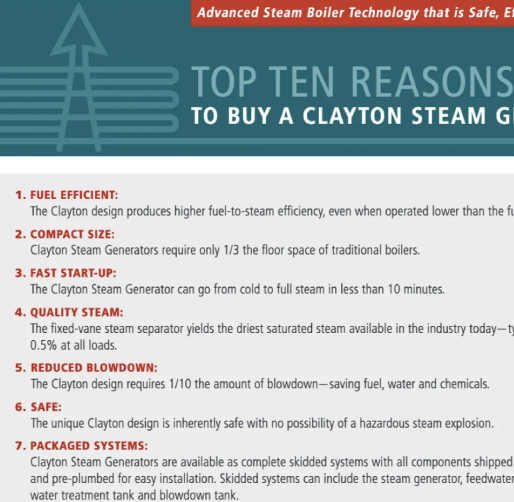
Top 10 Reasons To Buy a Clayton Steam Generator
1. FUEL EFFICIENT:
The Clayton design produces higher fuel-to-steam efficiency, even when operated lower than the full firing rate.
2. COMPACT SIZE:
Clayton Steam Generators require only 1/3 the floor space of traditional boilers.
3. FAST START-UP:
The Clayton Steam Generator can go from cold to full steam in less than 10 minutes.
4. QUALITY STEAM:
The fixed-vane steam separator yields the driest saturated steam available in the industry today — typically less then
0.5% at all loads.
Frequently Asked Question's
Steam supplies heat during the curing of an uncured, or “green,” tire inside a mold. This process vulcanizes the rubber, developing the properties needed for the finished tire. A reliable steam supply helps maintain the required curing conditions throughout each production cycle.
The required steam pressure depends on the curing equipment, rubber formulation, and production process. Specify the pressure and temperature required by the press manufacturer, together with peak steam consumption and cycle duration. Boiler selection should also account for pressure losses between the generator and the curing equipment.
Dry saturated steam supports controlled heat delivery during rubber curing. Excess moisture reduces the useful heat delivered per unit of steam and can affect heating performance. The steam supply and distribution system should maintain the conditions specified for the curing equipment.
Steam provides heat for phosphate baths used to prepare metal parts before painting or powder coating. Maintaining the specified bath temperature helps the phosphate treatment support coating adhesion and corrosion protection. Temperature control is therefore an important part of the pretreatment process.
Size the boiler around the highest realistic steam demand from equipment operating simultaneously. Include curing presses, heated process baths, startup loads, and distribution losses. Also review minimum demand between production cycles, since a system must operate effectively during both busy and quieter periods.
A compact steam generator can be suitable where floor space is limited. Clayton’s automotive page highlights a smaller equipment footprint than traditional firetube boilers. However, installation planning must also allow for maintenance access, water treatment, feedwater equipment, piping, and other supporting systems.
Start by repairing steam leaks, replacing faulty steam traps, and maintaining insulation. Returning suitable condensate to the boiler system can also reduce water and energy requirements. Regular boiler tuning and a planned maintenance program help keep the system operating efficiently.
Provide the required steam pressure, temperature, normal and peak flow rates, and production schedule. Include available fuel or electrical supply, feedwater conditions, installation space, and future expansion plans. Identify the processes the boiler will serve so Clayton’s team can assess an appropriate configuration.
Contact a Clayton Representative

sales@claytonindustries.com

800 423 4585 or +1 626 435 1200 PST
Contact a Clayton Representative